09-01-2026

Friday 9 January 2026
Patients with neuromuscular disorders (NMDs) constitute a vulnerable group when it comes to nutrition. Due to muscle weakness, reduced mobility, and swallowing difficulties, they are often fully dependent on enteral nutrition. At the same time, gastrointestinal symptoms such as reflux, vomiting, diarrhea, and constipation are common in this group, making nutritional care complex.
In the scientific literature, interest in enteral nutrition based on real food ingredients is growing. A recent publication by Di Pasquale et al. (Formula with real food ingredients for tube feeding in children with neuromuscular disorders – A case series) provides an initial insight into the potential role of this type of nutrition in children with neuromuscular disorders (NMDs).
The authors describe a case series involving five children with spinal muscular atrophy who were fully dependent on enteral nutrition. The children received a commercially available tube feeding partially composed of ingredients derived from real foods, such as vegetables, fruits, and animal protein sources.
The aim of the study was not to compare this feeding with standard tube feeding, but to evaluate:
whether the feeding is safe,
how well it is tolerated, and
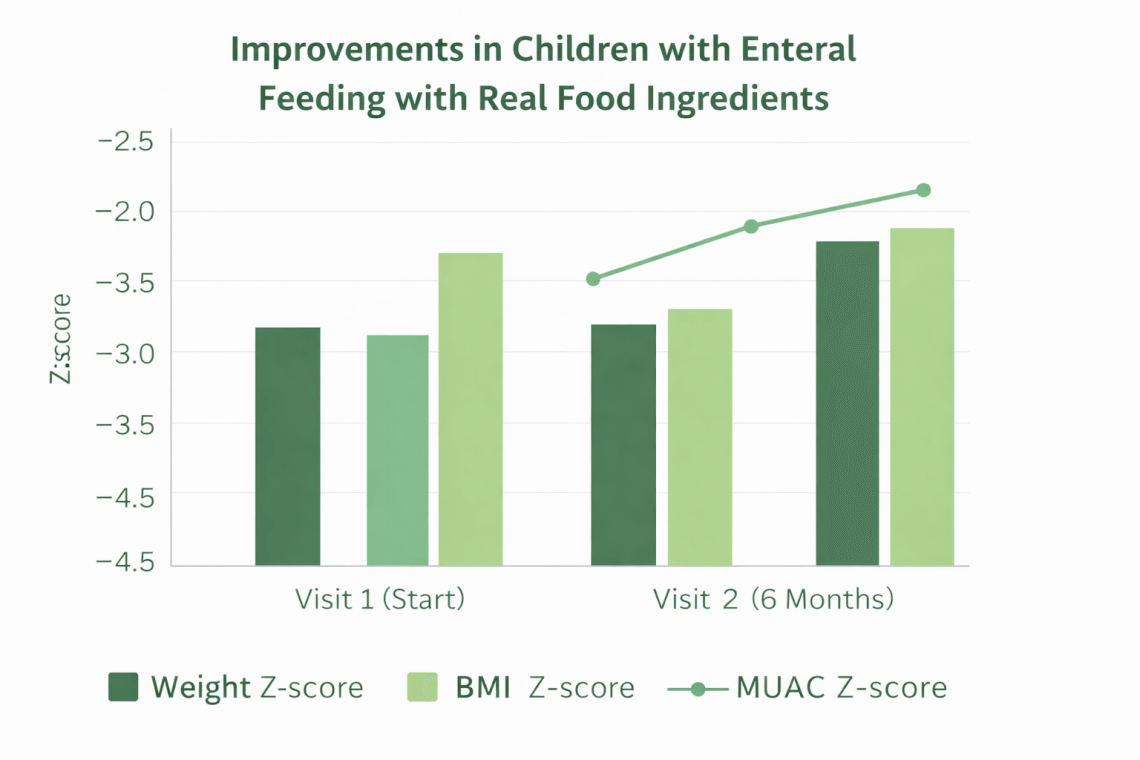
its effect on nutritional status over a six-month period.
The article emphasizes that children with neuromuscular disorders do not have a “standard” nutritional context. They often exhibit:
altered body composition (low muscle mass),
an increased risk of undernutrition, and
heightened sensitivity to gastrointestinal intolerance.
These factors mean that tolerance of enteral nutrition is at least as important as its nutritional composition on paper.
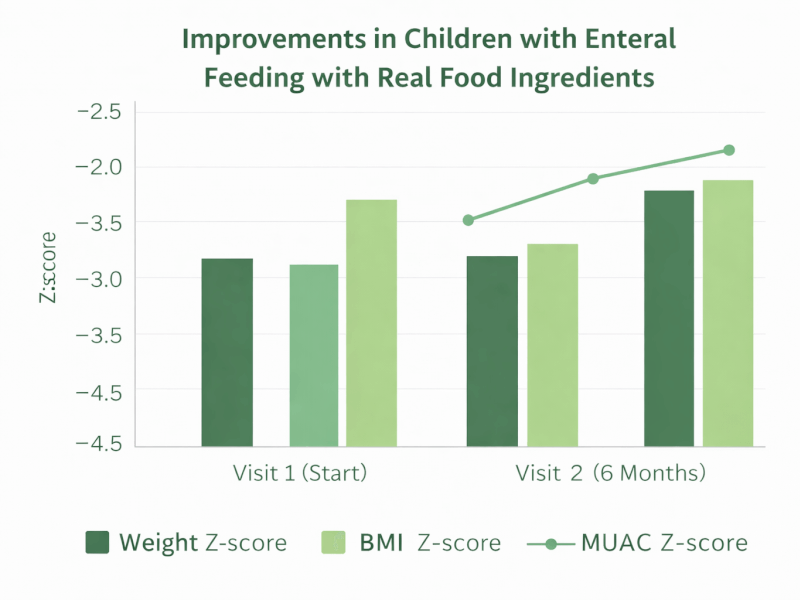
In this small case series, the feeding was well tolerated by all children. Parents reported a reduction or disappearance of symptoms such as vomiting, diarrhea, and bloating. In addition, improvements in weight and BMI were observed, indicating adequate energy intake.
Importantly, the authors do not draw causal conclusions. There was no control group and the number of patients was limited. Nevertheless, the findings are relevant, as they demonstrate that enteral nutrition containing real food ingredients can be feasible and well tolerated in this specific patient group.
The article discusses several possible explanations for the observed tolerance, without presenting them as proven mechanisms. These include:
the more complex food matrix of real ingredients;
the presence of different types of dietary fiber; and
a potential, but unmeasured, influence on the gut microbiome.
These hypotheses align with broader insights from nutritional science, but the authors emphasize that additional prospective research is necessary.
For dietitians and physicians, this publication suggests that enteral nutrition based on real ingredients:
may be a viable option for patients with persistent intolerance,
can be used safely within a controlled setting, and
warrants further scientific attention.
The article invites a broader discussion on how composition, degree of processing, and the food matrix of tube feeding relate to tolerance, particularly in vulnerable patient populations.
The case series by Di Pasquale et al. does not provide definitive evidence, but it does represent a carefully documented first step toward scientifically supporting enteral nutrition with real ingredients in neuromuscular disorders. The results highlight the need for further research and contribute to a more nuanced discussion on innovation in tube feeding.
Bron:
Dipasquale, V., Morello, R., Romano, C.
Formula with real food ingredients for tube feeding in children with neuromuscular disorders: A case series.
https://www.researchgate.net/publication/389142244_Formula_with_real_food_ingredients_for_tube_feeding_in_children_with_neuromuscular_disorders_NMDs_A_case_series