09-01-2026

Friday 9 January 2026
In children who depend on tube feeding, gastrointestinal (GI) symptoms and growth challenges play a major role in daily care. In addition to the composition of the nutrition, the method of administration intermittent bolus feeding or continuous feeding, also influences tolerance and effectiveness.
In children who depend on tube feeding, gastrointestinal (GI) symptoms and growth challenges are central to daily care. Beyond the nutritional composition, the method of administration-intermittent bolus or continuous feeding affects both tolerance and clinical outcomes.
A national multicenter retrospective study examined how these administration methods compare in children receiving enteral nutrition based on natural ingredients.
The study analyzed medical records of 43 children (1–17 years) from four hospitals who had transitioned to a feeding formula containing ingredients derived from real food. The formula provided at least 80% of energy requirements. The children received the nutrition via:
intermittent bolus feeding,
continuous feeding, or
a combination of both.
Over a one-month period, gastrointestinal symptoms, growth, and achievement of nutritional goals were evaluated.
The results reveal a clear pattern:
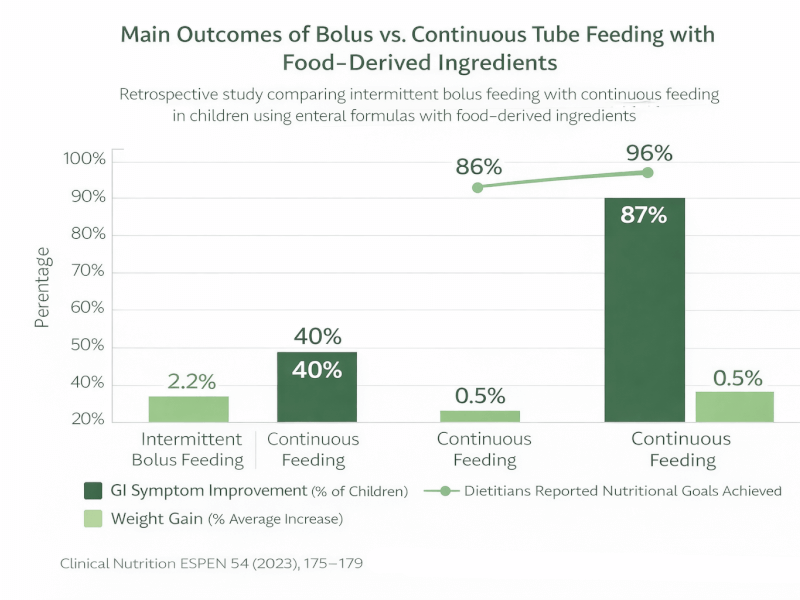
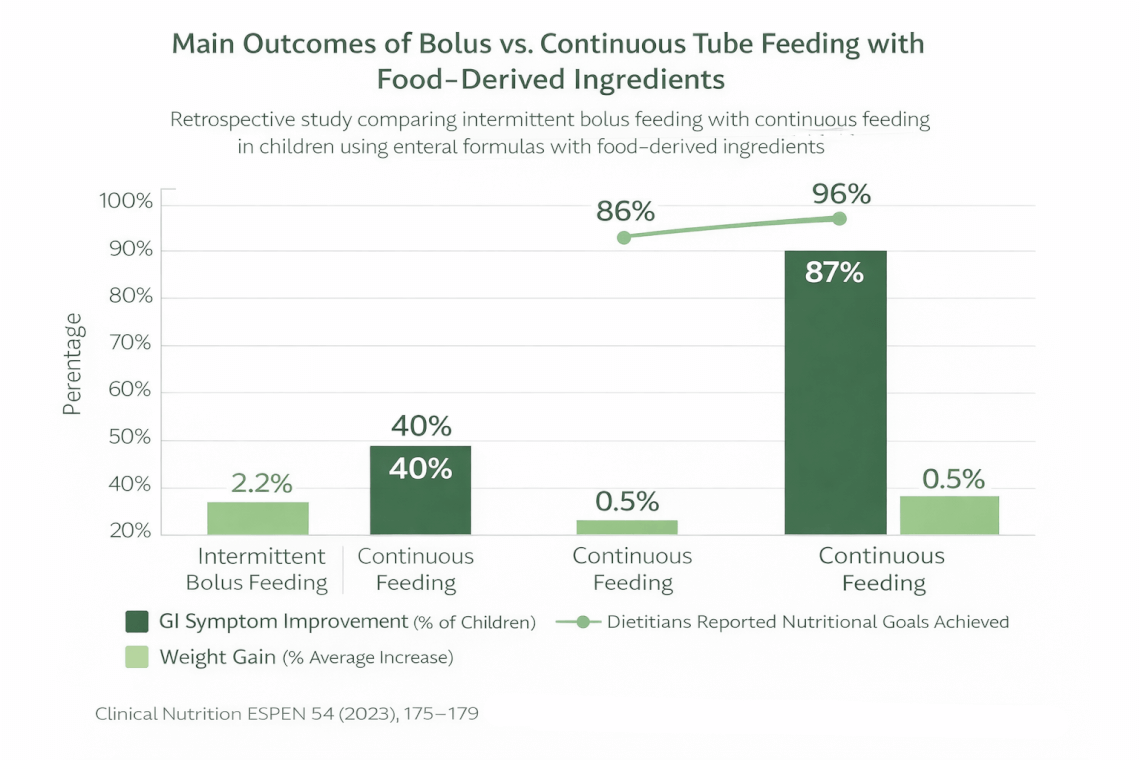
Continuous feeding was associated with the greatest reduction in GI symptoms, including vomiting, retching, abdominal pain, and loose stools.
Bolus feeding was associated with the greatest weight gain, which was statistically significant.
In all groups, the nutrition was well tolerated, and dietitians reported that nutritional goals were achieved in more than 90% of cases.
No significant differences were found in energy or fluid intake between the different administration methods.
For dietitians, this study provides several practical takeaways:
In children with persistent GI symptoms, continuous feeding may be an appropriate choice, particularly when combined with nutrition based on real ingredients.
In children for whom growth and weight gain are the primary goals, bolus feeding may offer advantages.
The study highlights that a hybrid approach (combining bolus and continuous feeding) can also be effective.
The choice of administration method remains individualized, depending on symptom profile, clinical context, and family circumstances.
This study shows that enteral nutrition containing ingredients derived from real food is flexible in its use and can be administered via both bolus and continuous feeding. For dietitians, this creates room to tailor the strategy to each patient, aligning it with symptoms, growth goals, and everyday practice.
Bron:
https://www.clinicalnutritionespen.com/article/S2405-4577(23)00031-1/fulltext